
Advancing Global Healthcare Leadership and Governance: Consortium Initiatives

These programmes provide unique opportunities for healthcare leaders worldwide to gain valuable cross-cultural experience, build professional networks, and work together to solve complex healthcare challenges that transcend national borders.
Global health policy and governance. The purpose of the consortium is analyse current approaches to healthcare governance and policymaking worldwide, identify best practices to be adopted more widely, and propose new policy and governance frameworks for improving global health outcomes.
Healthcare leadership development. A central focus of the consortium is to design innovative new programmes for training future generations of leaders who can navigate the unique challenges of healthcare management in today’s globalised world.
These programmes allow emerging leaders from diverse nations and healthcare systems to gain hands-on experience addressing shared healthcare issues.
Global health research networks. This consortium facilitates new collaborative research partnerships between healthcare researchers worldwide. By sharing knowledge, data, and expertise across borders, researchers can conduct more robust studies on healthcare challenges that affect populations globally.
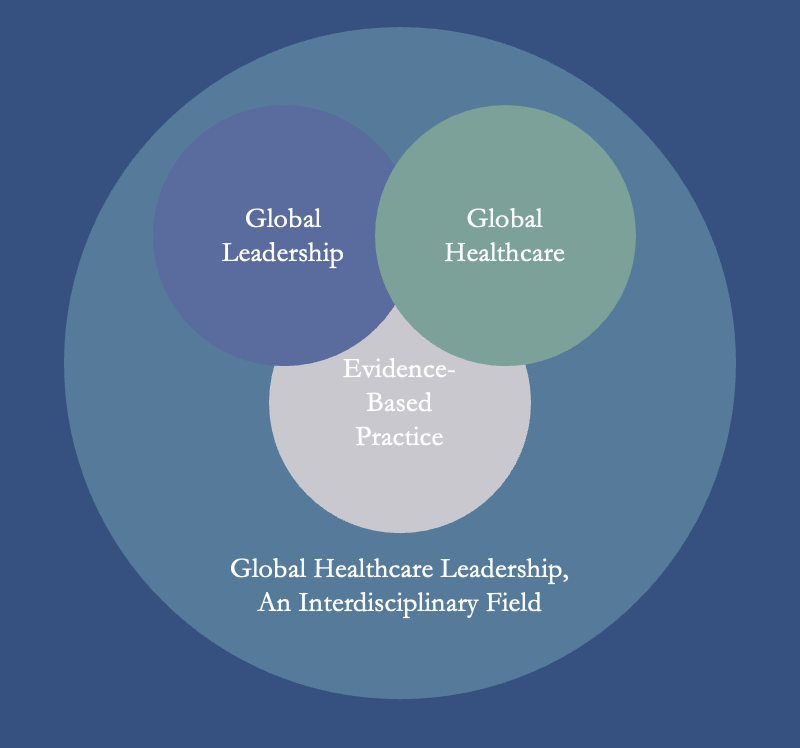
Initiative to Advance Global Healthcare Leadership
Global healthcare systems necessitate an innovative approach to leadership, particularly for non-clinical executives, to address growing complexities worldwide. Evidence-based practice combines the best known research with clinical expertise and patient values. There is a need to add evidence-based practice to postgraduate programme curricula to train healthcare leaders in best practices for decision-making, especially non-clinical executives.
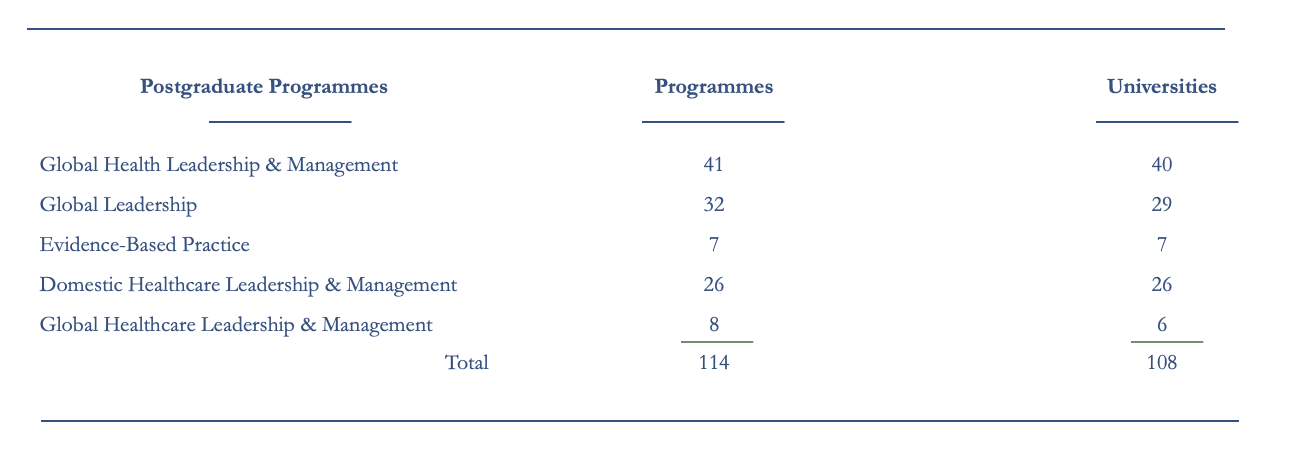
This research explores university postgraduate global healthcare leadership programme websites to learn the extent to which evidence-based practice competencies are incorporated into the programmes. A textual content analysis was conducted in review of 114 programmes at 108 universities. The findings reveal a noteworthy gap in the engagement of evidence-based competencies in non-clinical executive leader training.
The Academic Field of Global Healthcare
As an academic field, global healthcare is relatively new and has fewer programmes than domestic healthcare or public health. Its development has accelerated in recent decades, prompted by the increasing complexity of cross-border healthcare delivery. In contrast, global leadership has established itself as a distinct academic field, driven by the demand for internationally operating firms to develop global strategies, compete globally, and address the deficiency in specialised leadership (Reiche et al., 2017, p. 555).
Strategic governance across countries, unlike domestic value chains that operate within a single nation, requires knowledgeable global leadership, which exposes the complexities in leading the global enterprise (Gereffi, Humphrey, & Sturgeon, 2005).
After conducting Boolean searches and thoroughly reviewing the results, 114 programmes were compiled and categorised based on criteria such as the presence of terms like "global," "healthcare," "leadership," and “evidence-based” competencies in programme and module titles and descriptions. Additional factors included accreditation status, modality instruction (online, on-campus, or hybrid), programme location, and faculty expertise. Of the eight Global Healthcare Leadership & Management programmes and universities, only two are solely focused on Global Healthcare Leadership: University of Oxford, Nuffield Department of Primary Care Health Sciences and Saïd Business School (2024) and Keele University, School of Medicine (2024).
Summary of Postgraduate Universities & Programmes by Area of Study
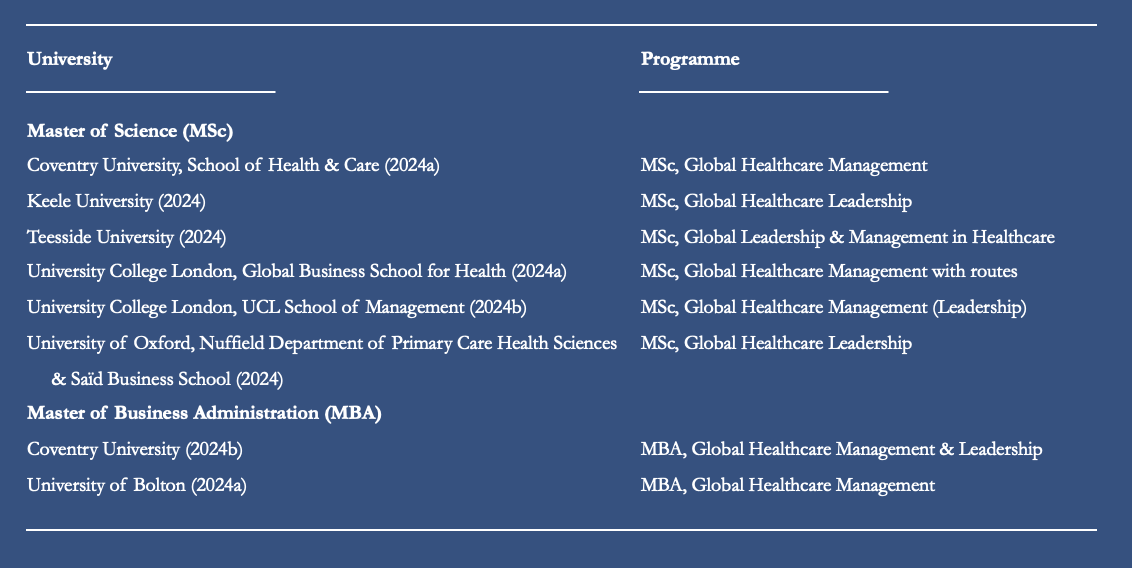
Comprehensive List of Global Healthcare Leadership & Management Postgraduate Programmes
The eight postgraduate programmes listed in this table are offered by six universities in the UK. They focus on Global Healthcare Management and Leadership. Academic schools and department include a Business School, Department for Primary Care Health Sciences, and School of Medicine.
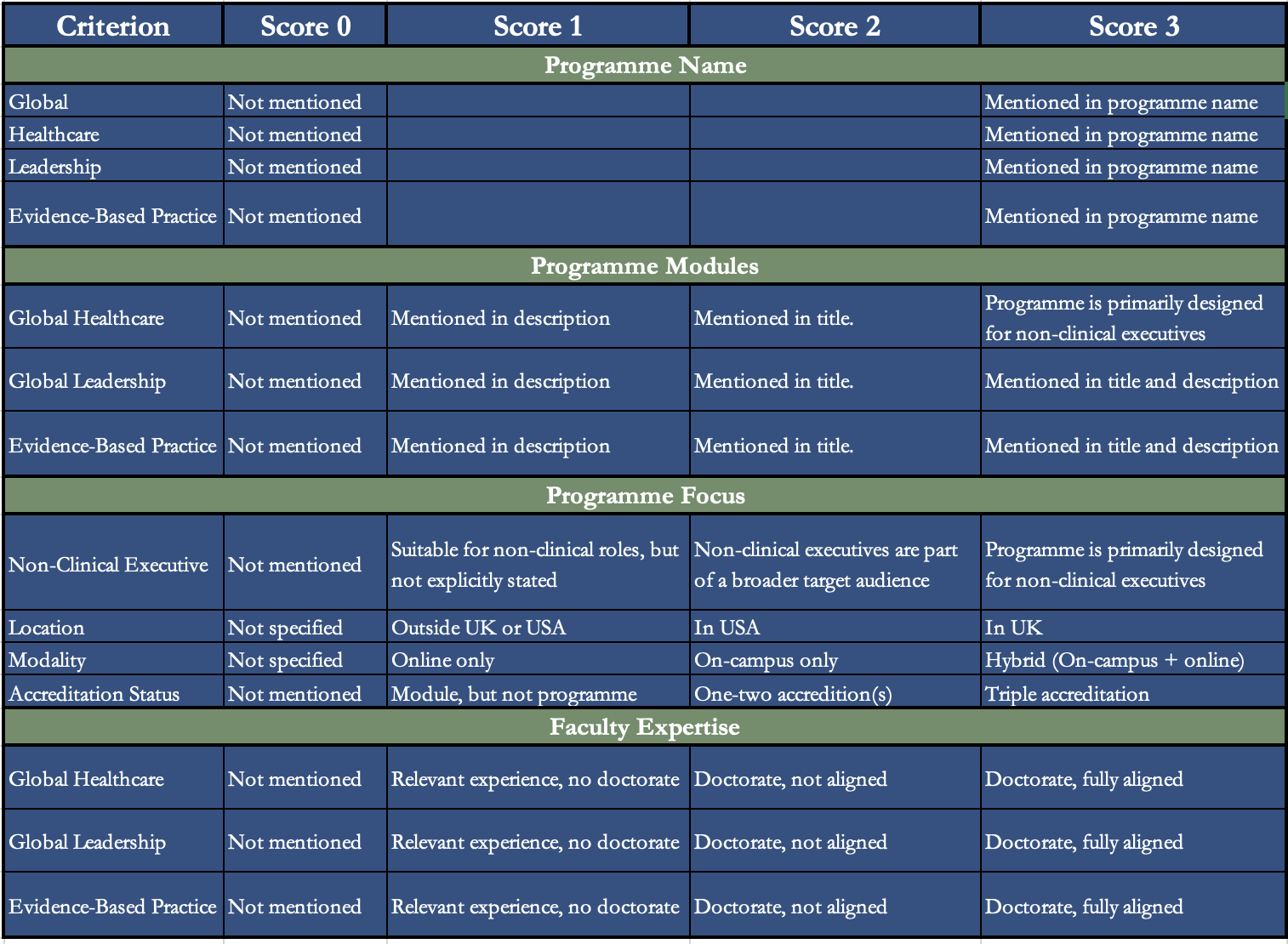
Scoring Rubric Criteria for Evaluating Global Healthcare Leadership Programmes
The rubric assigned scores based on the inclusion of specific keywords. For example, a programme featuring all four keywords—global, healthcare, leadership, and evidence-based practice—could receive a maximum score of 12, with 3 points for each keyword. Course titles and descriptions were evaluated with points granted for relevant terms.
Aggregate Score Range with Five Levels
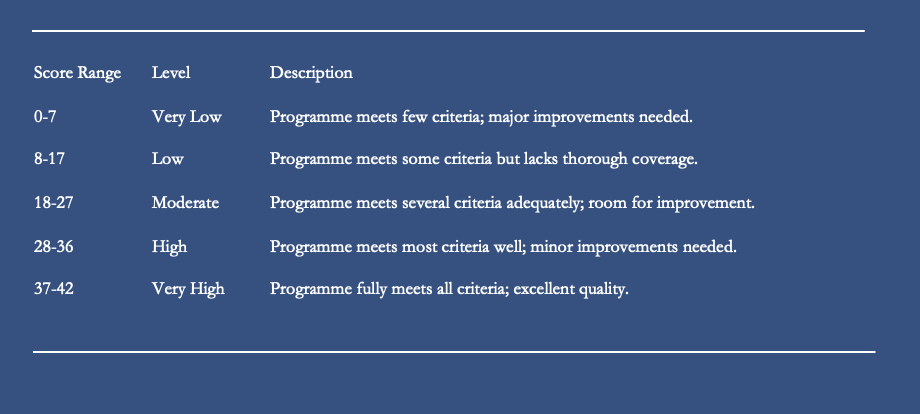
An aggregate score range with five levels—Very Low (0-7), Low (8-17), Moderate (18-27), High (27-36), and Very High (37-42)—was developed to measure the programme's alignment with the hypothesis. Empirical studies support the use of the Likert scale for its balance of simplicity, minimisation of response, and central tendency bias, making it effective for the content analysis (Preston & Colman, 2000; Hartley, 2013; Kusmaryono, Wijayanti, & Maharani, 2022; Braun & Clarke, 2006, p. 80).
Global Healthcare Leadership & Management Postgraduate Programmes: Aggregate Score
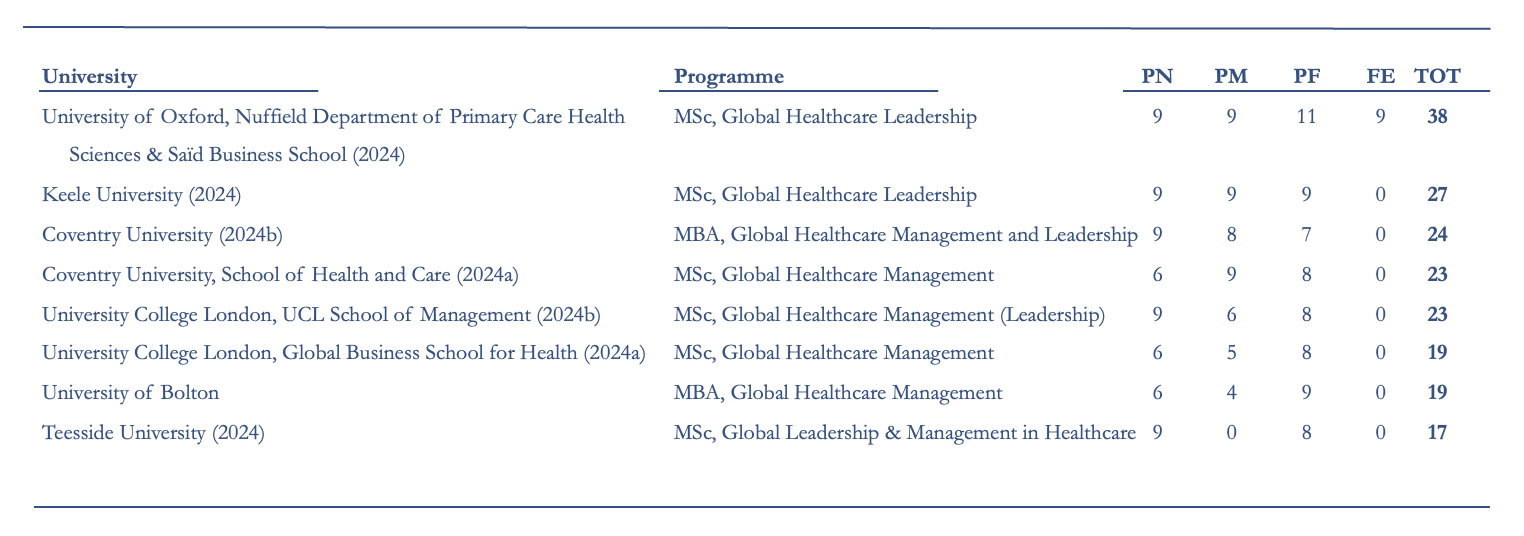
Note. PN=Programme Name; PM=Programme Modules; PF=Programme Focus; FE=Faculty Expertise; and TOT=Total.
University of Oxford was the only programme that scored “Very High” (University of Oxford, Nuffield Department of Primary Care Health Sciences & Saïd Business School, 2024). The significant difference in scores for Keele University (2024), Coventry University (2024b), Coventry University, School of Health and Care (2024a), and University College London, UCL School of Management (2024b) was the absence of information regarding faculty expertise.
Note. This analysis is not intended to reflect on the programmes' quality but to serve as a textual content analysis of how the programmes are represented on university websites as a first step in a primary source grey literature review.
References
Braun, V., & Clarke, V. (2006). Using thematic analysis in psychology. Qualitative Research in Psychology, 3(2), 77-101. https://doi.org/10.1191/1478088706qp063oa
Coventry University, School of Health and Care (2024a). Master of Science in Global Healthcare Management. Retrieved June 20, 2024, from https://www.coventry.ac.uk/course-structure/pg/hls/global-health-care-management-msc/
Coventry University. (2024b). Master of Business Administration in Global Healthcare Management and Leadership. Retrieved August 7, 2024, from https://www.coventry.ac.uk/london/course-structure/pg/global-healthcare-management-and-leadership-mba/
Gereffi, G., Humphrey, J., & Sturgeon, T. (2005). The governance of global value chains. Review of International Political Economy, 12(1), 78-104. https://doi.org/10.1080/09692290500049805
Hartley, J. (2013). Some thoughts on Likert-type scales. International Journal of Clinical and Health Psychology, 13, 83–86.
Keele University. (2024). Master of Science in Global Healthcare Leadership. Retrieved March 11, 2024, from https://www.keele.ac.uk/study/postgraduatestudy/postgraduatecourses/globalhealthcareleadership/
Kusmaryono, I., Wijayanti, D., & Maharani, H. R. (2022). Number of response options, reliability, validity, and potential bias in the use of the Likert scale education and social science research: A literature review. International Journal of Educational Methodology, 8(4), 625-637.
Mathis, S. D. (2024). Advancing global healthcare leadership: Enhancing evidence-based practice competencies in postgraduate programmes for non-clinical executives (Master's dissertation, University of Oxford, Reuben College). University of Oxford, Nuffield Department of Primary Care Health Sciences and Saïd Business School.
Preston, C. C., & Colman, A. M. (2000). Optimal number of response categories in rating scales: Reliability, validity, discriminating power, and respondent preferences. Acta Psychologica, 104(1), 1–15.
Reiche, B. S., Bird, A., Mendenhall, M. E., & Osland, J. S. (2017). Contextualizing leadership: A typology of global leadership roles. Journal of International Business Studies, 48, 552-572.
University College London, UCL School of Management. (2024b). Master of Science in Global Healthcare Management (leadership). Retrieved June 24, 2024, from https://www.ucl.ac.uk/prospective-students/graduate/taught-degrees/global-healthcare-management-leadership-msc
University of Oxford, Nuffield Department of Primary Care Health Sciences & Saïd Business School. (2024). Master of Science in Global Healthcare Leadership. Retrieved March 11, 2024, from https://www.sbs.ox.ac.uk/programmes/degrees/msc-global-healthcare-leadership